
Okay. Time for the much un-awaited second part. In the last post, I talked about the social aspect of being in a percussion ensemble, a concept that was not-so-familiar to me. This time, I'll talk about the not-so-pretty stuff of culture shock, namely the second stage: Disintegration.
Disintegration happens when you stop seeing things with rose-coloured glasses, when you stop being excited with being in and apart of something new. Alternatively, it could also occur when you're forced to participate in the new environment - you no longer have the neutrality of the outsider. You participate, rather than simply observe. Or for me, it was more of a sense of inadequacy. The feeling that you didn't belong in this new environment; you don't blend in.
This began as early as our second rehearsal. Our instructor, Louise, would split us up into smaller groups to come up with some original djembe rhythms. Rather than contribute, I was just sitting there receiving instructions. Being passive in the group made me feel useless. The issue resurfaced again in a later week, when we were split into smaller groups again to help compose a form for our marimba piece. I stood there...again, and watched... again. But I described things with more details this time. "This was supposed to be our chance to... improvise and construct a form for our piece. And yet, I found myself unable to contribute to the conversation, to etch a part of myself into our performance". I went on to relate this experience to basically all the group assignments I've ever done. "This always happens. In every single task that requires group work. Why am I so passive? I feel ignorant for not contributing, yet dying inside for not being able to say or think of anything useful". Given that this happened on our seventh rehearsal, I wasn't really expecting much of how this would change in the remaining rehearsals.
I believe my introverted personality did not make interacting any easier. Coupled with a mild case of anxiety, everyone in the room looked incredibly unapproachable to me. There were also few opportunities for us to interact. Most people cite ensemble activities as the perfect circumstances to interact with other people and develop a unified identity, which will confer that sense of belonging to them. However, I believe our sessions to be a little 'different' from your standard ensembles. A good number of us are beginners at music, that meant we needed more time to practice. And unfortunately, having two hours a week to learn and practice gives a group of novices very little time to catch up and prepare for an official public performance in ten weeks' time. My take on it would be, the situation just wasn't ideal for a bunch of strangers to come together and become the band of misfits they were destined to be.
Digging a little deeper into things, I started noting distinctive patterns in my journal entries. Usually, I'd just stay quiet in my first class and be that way for the rest of semester. But this time, there was a sense of positivity in the air during the first few classes (during the honeymoon phase). What set being in this class apart from the ones from previous semester is interest. A great deal of early excitement had actually stemmed from my personal interest in the content itself, which is percussion music. It's very subtle, but my journal entries documented great joy, but also sombreness every week. The joyous parts were usually directed at the music; while the sombre parts dealt with the social interactions (or lack thereof) happening in the class. And even then, repeating the same pieces week after week got boring really quick. In the end, there really wasn't much to look forward to anymore. Of course, that does not mean the music was always perfect for me, which I'll delve into a little later. The main point here, is that a great proportion of the semester was not a very fun time for me. I'd go in feeling 'motivated', and come out feeling...not-so-motivated. At one point, I described Monday afternoon rehearsals as 'fun, surreal and (slightly) depressing'.
These episodes continued on until my seventh rehearsal. With only two more weeks until showtime, it wasn't hard to think that my perception of Monday afternoon change much. However, I was slowly moving out of the disintegration stage and into reintegration. The key trait that denotes this phase is taking the self-loathing that you felt during disintegration and redirecting it towards those around you (a.k.a the host culture, or in this case, my ensemble classmates). It's incredibly difficult to reach out to someone in this stage because they are hostile and antagonistic to you. While I have not experienced this very much, I highlighted two key events that contained elements of this stage.
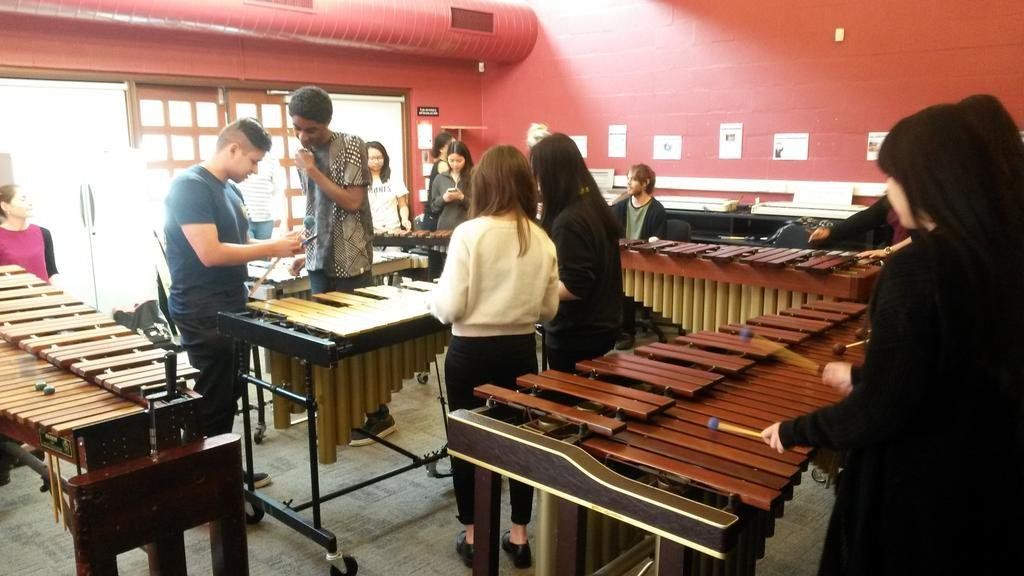
 Figure 1. Monday afternoon percussion rehearsals with other nonmusic majors. Photo taken at seventh rehearsal (week 8 or semester). Description: fun, surreal and (slightly) depressing.
The first was during our sixth 'gathering'. I say gathering because there wasn't an actual rehearsal that day. Louise had fallen ill that day and was unable to make it to rehearsals. Class was cancelled but no one was informed in advance. We all showed up normally only to be greeted by a short message at the door. My immediate reaction to reading it was shock and disappointment. I was probably genuine in feeling sad about the week's rehearsal being cancelled. In hindsight, that moment was pivotal in realising what my true feelings on the matter were. Yes, I actually like Monday afternoon percussion classes. Unfortunately, some of the remarks I heard from my peers were not too similar to mine. They weren't too happy about making the unnecessary trek all the way to the music school, among other things. It made me think that they didn't really care about music-making or anything. I was probably a little too harsh to think of them that way, but that was how I felt back then. While the musical and social aspects of ensembles were very much a black and white thing for me, I always believed that music was a non-verbal way of communicating with others. Those subtle cues that we were forced to perfect in order to make an ensemble performance work; I would also consider them a form of interaction within a musical setting. We listen for the signal, we check for visual cues, and we take in the myriad sounds that fill the air. When we do music, interactions aren't limited to words.
But I digress. Our viewpoints were clearly different, I thought. This was brought up again in our penultimate rehearsal. With only one week remaining, Louise briefed us through the schedule for the day - what to wear, what to bring, when to arrive. One question which hit me pretty hard was 'has anyone not seen the performance venue yet?'. Disappointed by the number of hands raised, I felt that my peers were simply not taking this seriously, or they just didn't have the interest to attend the weekly free concerts at the venue. 'How much are they actually interested in music-making? Were they just in it for the easy marks? What were their motivations for joining?', I asked myself. It looked like I was the only lunatic there who was actually finding percussion classes rewarding. Does everyone else see the marimba as just a piece of wood that makes sounds? Through these two events, I found myself growing antagonistic towards the other ensemble members, because it seemed like our interests and motivations differed.
Of course, with the power of hindsight, it looks a little silly to think that way. However, back then, these were my raw feelings. People fall into these situations all the time. They can't help it. That's why almost everyone suffers some degree of culture shock, no matter how hard they try. But I believe being honest and recording one's experiences in a journal can eventually help elicit these feelings and emotions. Stay tuned for the next part, finishing off the whole culture shock cycle with the autonomy and interdependence stage.
Listening to Kirifuda - cinema staff
These episodes continued on until my seventh rehearsal. With only two more weeks until showtime, it wasn't hard to think that my perception of Monday afternoon change much. However, I was slowly moving out of the disintegration stage and into reintegration. The key trait that denotes this phase is taking the self-loathing that you felt during disintegration and redirecting it towards those around you (a.k.a the host culture, or in this case, my ensemble classmates). It's incredibly difficult to reach out to someone in this stage because they are hostile and antagonistic to you. While I have not experienced this very much, I highlighted two key events that contained elements of this stage.
The first was during our sixth 'gathering'. I say gathering because there wasn't an actual rehearsal that day. Louise had fallen ill that day and was unable to make it to rehearsals. Class was cancelled but no one was informed in advance. We all showed up normally only to be greeted by a short message at the door. My immediate reaction to reading it was shock and disappointment. I was probably genuine in feeling sad about the week's rehearsal being cancelled. In hindsight, that moment was pivotal in realising what my true feelings on the matter were. Yes, I actually like Monday afternoon percussion classes. Unfortunately, some of the remarks I heard from my peers were not too similar to mine. They weren't too happy about making the unnecessary trek all the way to the music school, among other things. It made me think that they didn't really care about music-making or anything. I was probably a little too harsh to think of them that way, but that was how I felt back then. While the musical and social aspects of ensembles were very much a black and white thing for me, I always believed that music was a non-verbal way of communicating with others. Those subtle cues that we were forced to perfect in order to make an ensemble performance work; I would also consider them a form of interaction within a musical setting. We listen for the signal, we check for visual cues, and we take in the myriad sounds that fill the air. When we do music, interactions aren't limited to words.
But I digress. Our viewpoints were clearly different, I thought. This was brought up again in our penultimate rehearsal. With only one week remaining, Louise briefed us through the schedule for the day - what to wear, what to bring, when to arrive. One question which hit me pretty hard was 'has anyone not seen the performance venue yet?'. Disappointed by the number of hands raised, I felt that my peers were simply not taking this seriously, or they just didn't have the interest to attend the weekly free concerts at the venue. 'How much are they actually interested in music-making? Were they just in it for the easy marks? What were their motivations for joining?', I asked myself. It looked like I was the only lunatic there who was actually finding percussion classes rewarding. Does everyone else see the marimba as just a piece of wood that makes sounds? Through these two events, I found myself growing antagonistic towards the other ensemble members, because it seemed like our interests and motivations differed.
Of course, with the power of hindsight, it looks a little silly to think that way. However, back then, these were my raw feelings. People fall into these situations all the time. They can't help it. That's why almost everyone suffers some degree of culture shock, no matter how hard they try. But I believe being honest and recording one's experiences in a journal can eventually help elicit these feelings and emotions. Stay tuned for the next part, finishing off the whole culture shock cycle with the autonomy and interdependence stage.
Listening to Kirifuda - cinema staff
An Amateur Percussionist,
TK

